Coffee 101
What Is Washed Coffee? How It’s Made and How It Tastes
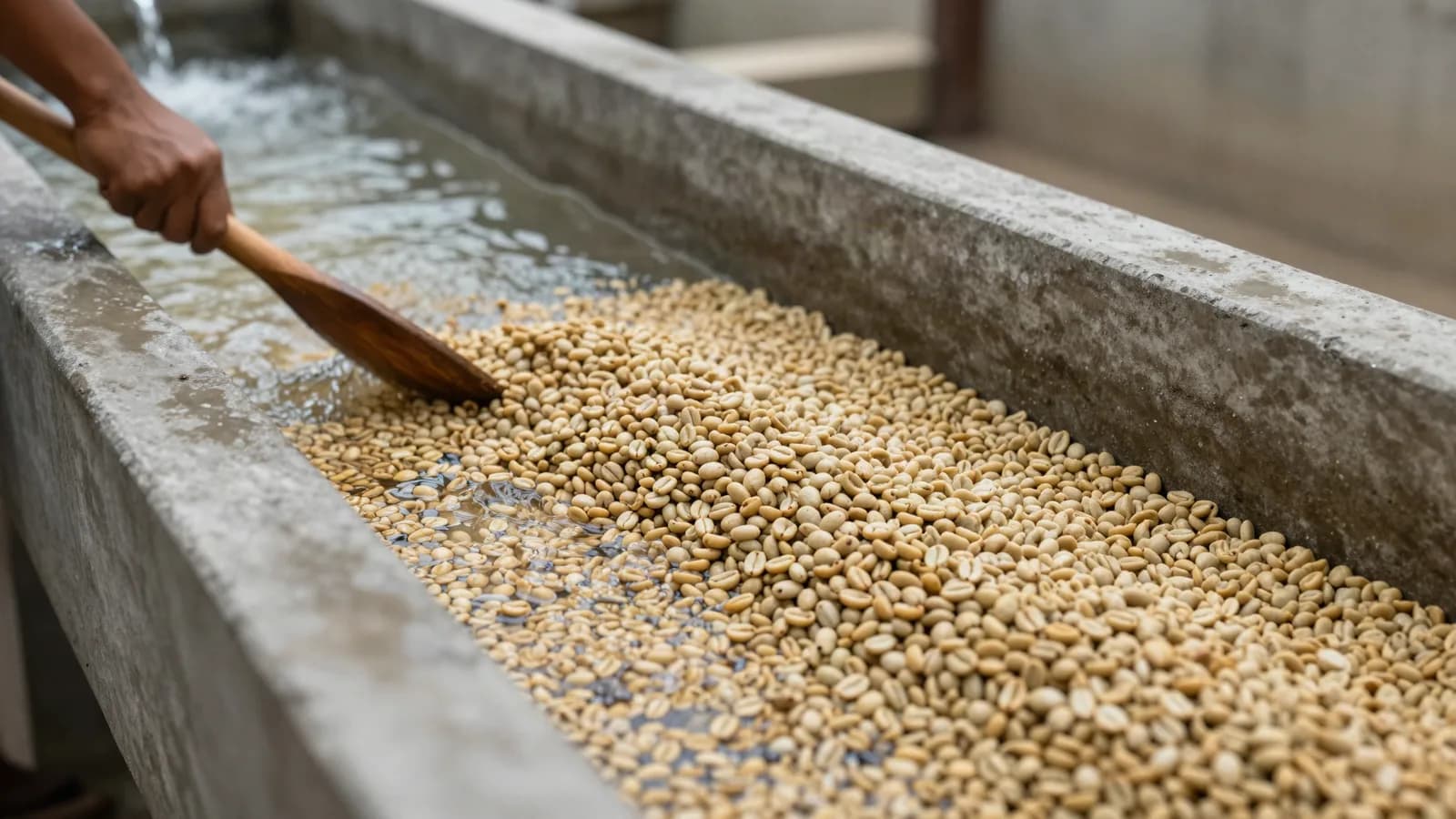
Washed coffee has its fruit taken off before the seed is dried. At a wet mill the cherries are pulped, the sticky mucilage left on each seed is usually broken down in a fermentation tank and rinsed away with water, and then the coffee dries. Washed coffees tend to taste clean and bright, with a lighter body.
I’m the head roaster at Beanlytics in Richmond, BC. Three of our washed coffees are the examples here: our Kenyan SL 28 and SL 34 from Karatina, our Sidra from Finca Terrazas del Pisque in Ecuador and Samuel Luna’s Pacamara from Finca Luna in El Salvador. For how every method compares, see how coffee processing shapes flavour.
What washed coffee is
Every coffee has to come out of its cherry and be dried before it can be roasted, and Perfect Daily Grind explains that processing methods differ mainly in the order of those two jobs. Carlos Oliveros of Cenicafé, Colombia’s coffee research centre, told Perfect Daily Grind that a washed coffee has lost its skin and mucilage before drying begins, leaving only the parchment (a papery shell) and the thin silverskin around the seed.
The method is also called wet process, or fully washed on some bags. Sprudge calls it the world’s leading way of preparing coffee for roasting, and Counter Culture Coffee says it gained popularity in the 1950s, when commercial processing equipment became available.
How washed coffee is made, step by step
1. Picking and floating
Ripe cherries are picked and tipped into water. Counter Culture Coffee describes this floating and sorting as the way producers keep ripeness consistent, and Carlos Oliveros explains that the cherries which float tend to be defective, damaged by the coffee berry borer or never fully ripened.
2. Pulping at the wet mill
The cherries go to a wet mill, also called a washing station, which Sprudge notes can be as simple as a large tub. A depulper, which Counter Culture Coffee describes as a machine that squeezes the fruit between rollers until the seeds pop out, removes the skin and most of the fruit. The seed is left in its parchment, still coated in mucilage, the sticky, sugary layer the next steps remove.
3. Fermentation tanks
The pulped coffee goes into tanks, where microbes and yeast break the mucilage down so it will wash off. Gloria Inés Puerta, a quality researcher at Cenicafé, told Perfect Daily Grind this usually takes 18 to 24 hours, depending on temperature. Sprudge and Nordic Brew Lab give wider ranges, up to about 72 hours.
Some producers skip the tank and scrub most of the mucilage off by machine, as Counter Culture Coffee notes. Perfect Daily Grind reports that Cenicafé has built equipment to get the same result with less water: its Ecomill cuts water use from 40 litres to between 0.3 and 0.5 litres per kilo of parchment coffee.
4. Washing and grading
Once the mucilage has loosened, the coffee is rinsed clean. Nordic Brew Lab describes a long, sloped channel of running water that carries off the residue and sorts the coffee as it goes, because dense, sound seeds sink while damaged ones are more likely to float. Some mills then soak the clean parchment in fresh water for a few hours or up to about a day.
5. Drying and resting
The wet parchment dries in the sun on patios or raised beds, or in mechanical dryers, until it reaches the right moisture for storage. Carlos Oliveros calls drying a high-risk stage, because microorganisms can damage the coffee. The dry coffee then rests in its parchment, Nordic Brew Lab notes, before it is milled and shipped.
How Kenya washes its coffee
Taya Brown, a coffee production researcher at the green importer Cafe Imports, told Barista Magazine that Kenyan coffee is often soaked in water after it has been fermented and washed, which is why the method is called the Kenyan process or double washed. It began as a practical fix: when more coffee reached the mill than the drying beds could hold, washed coffee was kept under water, cool and safe from insects, until space opened up. Perfect Daily Grind, drawing on Pil Hoon Seu of Coffee Libre, notes that the second soak uses more water and gives a very clean coffee.
Barista Magazine describes Kenyan coffees as high in acidity, with fruity, floral notes, though Brown says the varieties grown in Kenya likely account for much of it. Our Kenyan lot comes from Karindundu in Karatina, Nyeri County, at 1,700 masl, and the lot is SL 28 and SL 34; our guide to SL28 coffee covers SL 28. It cups as black currant and blood orange with ripe mango, carried by a sparkling, almost effervescent acidity. Its lot record says washed without saying how many times it was soaked, so I won’t claim the double wash for it.
Why washed coffee tastes clean and bright
Perfect Daily Grind puts it down to the mucilage. In a natural or a honey, the fruit left around the seed keeps fermenting while the coffee dries, which marks the flavour and makes the cup harder to predict. In a washed coffee all the fermentation happens at the start, in the tank, where it is easier to control. What you taste is mostly the seed: its variety and where it grew.
Counter Culture Coffee describes washed coffees as having higher acidity, brighter fruit flavours and a lighter body. Stephen Gray, head of coffee at Origin Coffee Roasters, told Perfect Daily Grind that a washed coffee leans toward crisp, fresh fruit and florals, a natural toward ripe or stewed fruit with some booziness.
Clean is a flavour word: Counter Culture Coffee points out that washing doesn’t make a coffee any cleaner in the everyday sense, and Nordic Brew Lab warns that a washed coffee can still taste fermented if the tank runs too long.
Three washed coffees, three different cups
Our washed lots show how much variety and place matter. The Sidra from Finca Terrazas del Pisque grows at 2,100 masl in Pichincha, Ecuador, and tastes of cooked lemon, caramel and cocoa, with balanced acidity and a mellow, fruit-like sweetness; our Sidra coffee guide explains the variety. Samuel Luna’s Pacamara, grown at 1,450 masl in Citalá, Chalatenango, gives nutmeg and mild fresh fruit with lots of tart acidity, and our guide to Pacamara coffee covers that variety. Add the Kenyan’s black currant and blood orange and you have three coffees washed the same basic way that taste very different.
Washed vs natural vs honey
| Washed | Honey | Natural | |
|---|---|---|---|
| Taken off before drying | Skin, fruit and mucilage | Skin and fruit; some or all of the mucilage stays on | Nothing; the whole cherry dries |
| Where fermentation happens | In a tank, before drying | In the mucilage, early in drying | Inside the fruit, during drying |
| Water | The most | Little or none | Little, mainly for floating the cherries |
| Typical cup | Clean, higher acidity, lighter body | More body than washed, often some fruit | Fruit-forward, fuller body |
Washed vs natural
A natural (dry process) coffee dries inside the whole cherry and loses its fruit only afterwards; Counter Culture Coffee says the drying normally takes three to six weeks. Washing has costs: Sprudge notes it needs more water and power than a natural, and Perfect Daily Grind adds that its wastewater, poorly disposed of, can carry chemicals into local waterways. Where a producer lacks fresh water or equipment, Counter Culture Coffee says, a natural may be the better choice.
Washed vs honey
A honey coffee is pulped like a washed coffee, then skips the tank and the rinse and dries with its mucilage on. Royal Coffee’s Chris Kornman notes that any breakdown of the mucilage in a honey happens early in drying, outside a controlled tank. George Howell, founder of George Howell Coffee, told Perfect Daily Grind that honey and natural processing add body and often fruit. Our guide to honey process coffee covers it step by step.
Where anaerobic coffee fits
Sprudge calls washed a catch-all term, and Cafe Imports separates processing methods such as washed from fermentation methods such as anaerobic, in which coffee ferments in a sealed, low-oxygen container. The two can be combined. Our Sidra from El Diviso in Huila is listed as anaerobic washed, and what anaerobic coffee is explains how that changes the cup.
Brewing a washed coffee
Nordic Brew Lab suggests giving a washed coffee that tastes thin or sharp a little more extraction: slightly hotter water, about 94°C to start, and an even pour split into four or five pours. Our Kenyan is marked for filter, pour-over, French press and drip, the Sidra from Ecuador for espresso and filter, and the Pacamara for espresso, filter, pour-over, French press, drip and cold brew.
Questions people ask
What is a washed coffee bean?
It is a coffee seed that had its skin, fruit and mucilage removed before it was dried, usually by pulping, fermenting in a tank and rinsing with water. The label describes what happened at the mill where the coffee grew.
Is natural or washed coffee better?
Neither is better by itself. Counter Culture Coffee says that calling a natural better for being natural, or a washed coffee better for being clean, misreads the names. It comes down to taste: in a Perfect Daily Grind survey, 52% of people preferred washed and 28% natural. For clarity and acidity, start with a washed coffee; for big fruit and body, try a natural.
What is the difference between washed and fully washed coffee?
Usually none. Fully washed makes clear that the coffee was pulped, fermented and washed before drying, rather than put through a hybrid method such as semi-washed, pulped natural or honey. Royal Coffee’s Chris Kornman points out that those hybrid names have no standard definitions, so one producer’s honey can be another’s semi-washed.
What is the main goal of washed coffee processing?
To get the fruit off the seed as soon as possible after picking, before drying begins, which Counter Culture Coffee says also lowers the risk of flavour defects. Nordic Brew Lab describes it as a method designed for clarity, so the cup tastes of the coffee’s variety and origin more than of fermentation.
What are the three types of coffee processing?
Washed, natural and honey, which Barista Magazine calls the classic processes. Washed takes the fruit off before drying, natural dries the whole cherry, and honey takes off the skin and fruit but dries with the mucilage on. Others exist, such as the wet-hulled method common in Indonesia.
These three, plus Maria Zelaya Aguirre’s Pacas and Java from Antigua, Guatemala, and Elias Roa Parra’s decaf from Acevedo, Huila, are on our washed-process coffees page, roasted to order in Richmond, BC and shipped across Canada.