Origins & Sourcing
Brazilian Coffee Guide: Origin, Flavor & Sourcing
Brazil grows about a third of the world’s coffee, more than any other country, which is exactly why it is misunderstood.
Most Brazilian coffee is commodity-grade, blended into supermarket tins and espresso fillers, and that reputation follows the whole origin around.
Specialty Brazil is a different drink: chocolate, almond and caramel sweetness with a soft, low-acid body that makes it the most approachable cup in specialty coffee.
This guide covers where Brazilian coffee grows, why it tastes the way it does, how the natural process shapes it, and which estate ours comes from.
Is Brazil the world’s largest coffee producer?
Yes. Brazil has been the world’s largest coffee producer for over 150 years, growing roughly a third of global supply, more than the next two countries combined.
It produces both arabica and robusta at enormous scale across a coffee belt bigger than most countries. That scale is why “Brazilian coffee” became shorthand for cheap, blend-base coffee, but scale and quality aren’t the same thing.
The same country that fills commodity warehouses also produces award-winning micro-lots from family estates, and the gap between the two is wider than almost anywhere else on Earth.
Where Brazilian Coffee Grows
Brazil’s coffee comes from a cluster of states in the country’s southeast, each with its own signature:
- Minas Gerais. The heartland, home to the Cerrado Mineiro (Brazil’s first denomination of origin) and Sul de Minas, which together produce the bulk of the country’s specialty coffee. Cerrado Mineiro is where ours grows.
- São Paulo. The historic Mogiana region, where volcanic soils and rolling highlands produce some of Brazil’s most refined, sweet lots.
- Espírito Santo and Bahia. The robusta strongholds and newer high-tech arabica frontiers, respectively.
One number explains a lot about the flavor. Brazilian coffee mostly grows between 900 and 1,300 meters, noticeably lower than the 1,800 to 2,200 meters of an Ethiopian or Colombian highland lot.
Lower altitude means warmer nights and faster cherry ripening, which builds less of the sharp acidity that defines high-grown coffee and more of the round, chocolatey sweetness Brazil is loved for.
It is not a lesser cup. It is a different one, shaped by geography. Our own lot sits above that band, at 1,450 meters on the Cerrado plateau, which is part of why it carries more fruit than the Brazilian stereotype.
| Region | State | Known for | Our lot |
|---|---|---|---|
| Cerrado Mineiro | Minas Gerais | Brazil’s first denomination of origin | Yes, at 1,450 m |
| Sul de Minas | Minas Gerais | With Cerrado, produces the bulk of the country’s specialty coffee | — |
| Mogiana | São Paulo | Volcanic soils and rolling highlands; refined, sweet lots | — |
| Espírito Santo and Bahia | — | Robusta strongholds and newer high-tech arabica frontiers | — |
Most Brazilian coffee grows between 900 and 1,300 metres, against the 1,800 to 2,200 metres of an Ethiopian or Colombian highland lot. That gap is most of the flavour difference.
Yellow Catuaí and Brazil’s Workhorse Varieties
Brazil’s specialty coffee runs on a handful of arabica varieties bred for its climate: Bourbon and Mundo Novo for sweetness and structure, and Catuaí, a compact, high-yielding cross of Mundo Novo and Caturra developed in Brazil itself.
Our lot is Yellow Catuaí, the yellow-cherry selection, picked selectively at Fazenda Sao Luiz. It is a variety built for exactly the profile Brazil does best: reliable, deep, chocolate-and-nut character, with more fruit than the stereotype suggests.
What Does Brazilian Coffee Taste Like?
Brazilian coffee tastes of chocolate, nuts and caramel, with low acidity and a heavy, smooth body. It is the definition of a comfort cup.
Where an Ethiopian coffee is bright and floral, a good Brazil is round and sweet, the kind of coffee that tastes right with milk, early in the morning, or as the backbone of an espresso.
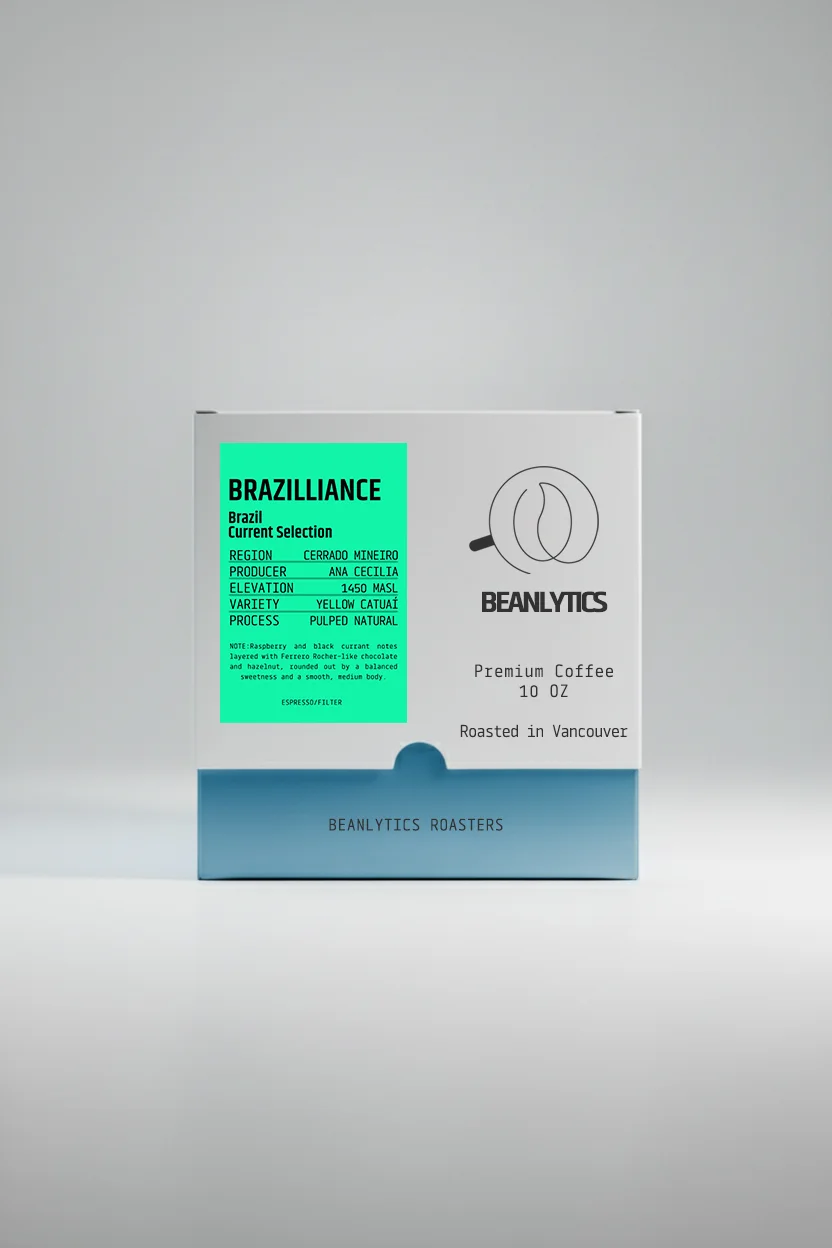
Our lot, Brazil Yellow Catuai, shows both sides: raspberry and black currant over Ferrero Rocher-like chocolate and hazelnut, with balanced sweetness and a smooth, medium body.
It is the coffee we hand people who think they don’t like specialty coffee, because it delivers everything they already love about coffee, just cleaner and fresher.
The Natural Process
Brazil essentially wrote the book on natural (dry) processing, drying the whole coffee cherry intact in the sun so the fruit’s sugars soak into the bean before hulling.
The reliably dry harvest climate made it possible at scale, and it is a large part of why Brazilian coffee is so sweet and full-bodied: the extended contact with the fruit builds sweetness and body rather than the bright acidity a washed process preserves.
Ours goes a step further into pulped natural, where the skin is removed but the sticky mucilage stays on the bean through drying.
It keeps much of the sweetness and body of a full natural while giving a cleaner, better-defined cup, and it is a Brazilian specialty.
For the deeper mechanics, we have written about how processing shapes flavor in specialty coffee.
How We Source Our Brazilian Coffee
Our Brazil comes from Fazenda Sao Luiz, a family-owned estate in the Cerrado Mineiro at 1,450 meters.
The family has grown coffee there for over a century, and the farm is run today by Ana Cecilia Gondim Velloso and her brother Lucio.
The Velloso family combines scientific method with traditional growing knowledge, and Sao Luiz was one of the first farms in the region to invest in advanced coffee technology.
The practices behind our lot are specific: selective harvesting of the ripest Yellow Catuaí cherries, natural drying, and compost-based fertilization.
Every batch is traceable from tree to export. This isn’t anonymous blend-base coffee, it is a named estate with named producers and a record to stand behind, which is the same standard we hold every lot to.
We cover it in how sustainable coffee sourcing impacts every cup.
How to Brew Brazilian Coffee
Espresso first.
Brazil is the classic espresso base for a reason: its low acidity and heavy body pull a thick, sweet, chocolatey shot that stands up to milk, so it is the coffee to reach for if you are building a flat white or a morning latte.
Aim for a standard 1:2 ratio and let the sweetness lead.
For filter, lean into comfort. A French press or a full-immersion brew at a 1:15 ratio brings out the body and the nutty, chocolate depth.
It is forgiving coffee and hard to make taste bad, but dialing in the coffee-to-water ratio still takes it from good to genuinely great.
Common Questions
Why is Brazilian coffee low in acidity?
Two reasons stack. First, altitude: Brazil’s coffee grows lower than most origins, so cherries ripen in warmer conditions that develop less of the malic and citric acidity of high-grown coffee.
Second, processing: the natural, sun-dried method builds sweetness and body rather than preserving brightness. Together they produce the smooth, mellow cup Brazil is known for.
Is Brazilian coffee good for espresso?
It is arguably the best. Brazil’s low acidity, heavy body and chocolate-nut sweetness are exactly what a great espresso wants.
It is the traditional heart of Italian espresso blends, and a specialty Brazil pulls a shot that is sweet and syrupy on its own and excellent under milk.
What’s the difference between commodity and specialty Brazilian coffee?
Everything except the country. Commodity Brazil is bulk-graded, blended and sold anonymously on price.
Specialty Brazil, like our Sao Luiz lot, is a traceable single estate, selectively harvested, cupped and scored for quality, and roasted fresh in small batches. Same origin, completely different drink.
The Bottom Line
Brazil is the origin everyone has tasted and almost nobody has tasted well.
Behind the commodity reputation is the world’s most reliable comfort cup: deep chocolate, almond and caramel from a country that has spent 150 years perfecting sweetness and body.
If you love a smooth, low-acid coffee that works black or with milk, this is your origin. If you want the opposite end of the spectrum next, our Ethiopian coffee guide covers the bright, floral flip side.
Try it fresh: our Brazil Yellow Catuai, pulped-natural from Fazenda Sao Luiz, roasted to order, or keep a rotating box of coffees like it with a Beanlytics subscription.
You can see the Brazilian lots we are roasting now, Catuai and otherwise, on our Brazilian coffee page.