Origins & Sourcing
Ecuadorian Coffee Guide: Origin, Flavor & Sourcing
Ask most coffee drinkers to name a great coffee origin and you will hear Ethiopia, Colombia, maybe Kenya.
Almost nobody says Ecuador, which is exactly why the people who have tasted a great Ecuadorian lot tend to talk about it in hushed tones.
Ecuador produces a fraction of what its neighbors grow, but the best of it competes with coffees twice its price.
This guide covers where Ecuadorian coffee comes from, what makes it taste the way it does, the variety putting the country on the specialty map, and how we source ours.
Does Ecuador grow coffee?
Yes. Ecuador grows both arabica and robusta, and its high-altitude Andean valleys produce small lots of exceptional specialty arabica.
Growing regions like Loja, Pichincha and Imbabura sit between roughly 1,200 and 2,000 meters, where slow cherry maturation builds sweetness and complexity.
Total production is tiny next to Colombia or Brazil, which is exactly why Ecuador’s best lots, including varieties like Sidra, are rare and sought after by specialty roasters.
Why Ecuador Is Specialty Coffee’s Best-Kept Secret
Ecuador sits on the equator between two coffee giants, Colombia to the north and Peru to the south. It has everything great coffee needs: extreme altitude, volcanic soil and dramatic microclimates. What it doesn’t have is volume.
Ecuador’s production is tiny by neighboring standards. Most farms are small, costs are high, and for decades the country’s beans were blended away into anonymity.
That changed when a handful of producers stopped competing on volume and started competing on quality. High-altitude farms began planting exceptional varieties, refining their processing, and selling directly to specialty roasters.
Ecuador has become the origin insiders watch: small harvests, remarkable cups.
If you see a single-origin Ecuadorian coffee on a menu, it is there because someone fought to get it there.
Where Ecuadorian Coffee Grows
Coffee grows across two very different Ecuadors: the Andean highlands, and the lowlands toward the coast and the Amazon. Specialty coffee is a highland story.
Pichincha
The province surrounding Quito, high on the Andean slopes. Farms here reach extreme elevations of 1,800 to over 2,200 meters above sea level, among the highest coffee grows anywhere on Earth.
Cool nights at this altitude slow cherry maturation dramatically, packing density and sweetness into every bean. This is where our own Ecuadorian lot comes from.
Loja
The southern highlands, generally considered Ecuador’s historic quality heartland. High-altitude valleys around Vilcabamba and Quilanga produce classic, structured, sweet cups.
Imbabura and Carchi
Northern provinces near the Colombian border. An emerging zone with profiles that echo the best coffees across the border in Nariño: bright, floral, intense.
Zamora-Chinchipe and the south-east
On the Amazonian side of the Andes, a wetter, greener growing environment producing rounder, fruit-forward coffees.
| Region | Altitude | Known for | Our lot |
|---|---|---|---|
| Pichincha | 1,800 to over 2,200 m | Among the highest coffee farmland on Earth | Yes |
| Loja | High-altitude valleys | Ecuador’s historic quality heartland; structured, sweet cups | — |
| Imbabura and Carchi | — | Emerging northern zone echoing Nariño: bright, floral, intense | — |
| Zamora-Chinchipe and the south-east | — | The Amazonian side; wetter, greener, rounder and fruit-forward | — |
The Sidra Variety: Ecuador’s Signature
Every origin has a variety it is known for. Ethiopia has its heirlooms, El Salvador has Pacamara, and Ecuador increasingly has Sidra.
Sidra is a rare variety that emerged in Ecuador and remains strongly associated with it.
Its exact parentage is still debated among researchers. It is commonly described in relation to Typica and Bourbon lineages, though genetic studies have complicated that story. What isn’t debated is the cup.
Sidra is regularly described as one of the most complex-tasting varieties in specialty coffee: florals, red fruit, silky body, and a long, sweet finish.
It has become a fixture in barista championship routines, which has pushed demand and prices steadily upward.
Sidra is demanding to grow, yields modestly, and rewards high altitude, which is why Ecuador’s extreme elevations suit it so well.
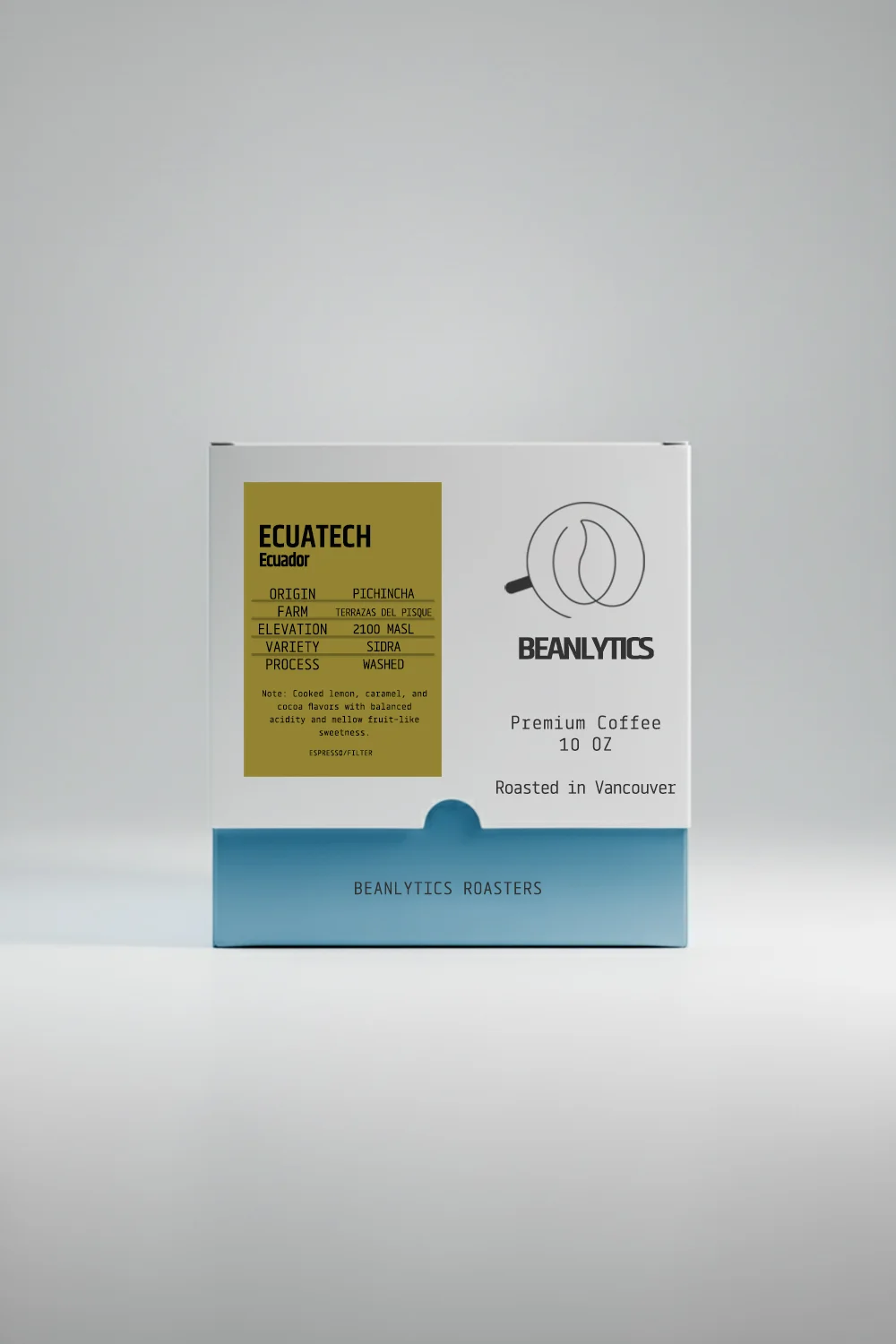
Want to taste it? Our Ecuador Sidra is a washed Sidra grown at 2,100 masl in Pichincha.
What Does Ecuadorian Coffee Taste Like?
Generalizing an origin is always risky, but high-grown Ecuadorian coffee tends toward:
- Florals. Jasmine and blossom aromatics, especially in Sidra and Typica lots.
- Red and stone fruit. Plum, red apple, sometimes tropical notes in naturals.
- Structured sweetness. Panela and caramel rather than heavy chocolate.
- Bright but polished acidity. Lively without sharpness, thanks to slow high-altitude maturation.
- Silky body. Lighter than a Brazil, rounder than many Ethiopians.
If your palate leans fruity and floral, Ecuador belongs on your shortlist. If you prefer chocolate-and-nut comfort coffees, start with our chocolate & nutty lots instead. Different tools for different moods.
Washed Processing at Altitude
Most of Ecuador’s standout lots, ours included, are washed (wet-processed). The cherry is de-pulped, fermented to loosen the remaining fruit, washed clean, then dried.
Washed processing strips away everything but the seed itself, which makes it the most transparent lens on variety and terroir.
For a variety as expressive as Sidra, that transparency is the point: nothing stands between you and what 2,100 meters of altitude does to a coffee seed.
How We Source Our Ecuadorian Coffee
Our Ecuador lot, Our Ecuador Sidra, comes from Finca Terrazas del Pisque in Pichincha, grown at 2,100 meters above sea level, genuinely among the highest-grown coffees we have ever offered.
- Farm: Finca Terrazas del Pisque, Pichincha, Ecuador
- Elevation: 2,100 masl
- Variety: Sidra
- Process: Washed
- Roasted: to order in Richmond, BC, and dispatched within 1 to 2 business days of roasting
Every bag is traceable to this farm and this harvest, which is the standard for everything we roast. You can read more about how we choose our partners in our sourcing philosophy.
Sourcing choices shape the cup as much as altitude does. Here is how sustainable coffee sourcing impacts every cup.
Is Ecuadorian Coffee Good? (The Honest Answer)
Yes, with a caveat. Ecuador’s average coffee is unremarkable; its best coffee is excellent. Because volumes are small, quality varies more lot to lot than in origins with huge, standardized export systems.
The fix is simple: buy from roasters who name the farm, the variety and the elevation. If a bag just says “Ecuador,” skip it.
If it says Sidra, Pichincha, 2,100 masl, that is a coffee someone selected on purpose.
How to Brew Ecuadorian Coffee
High-grown washed lots like ours shine with brew methods that highlight clarity:
- Pour-over (V60, Kalita). The florals and acidity come through cleanest.
- Aeropress with a coarser grind and a longer steep. Rounder, still articulate.
- Skip the dark-roast espresso habits. This isn’t a coffee to bury under milk.
Start around a 1:16 coffee-to-water ratio and adjust to taste. Our coffee-to-water ratio guide walks through exactly how.
Common Questions
Is Ecuadorian coffee expensive?
Costs are genuinely higher: small farms, high altitudes, hand labor, low volume. You are paying for scarcity and selection, not marketing.
Does Ecuador only grow arabica?
No. Robusta grows in the lowlands, but specialty Ecuadorian coffee is arabica, and the lots worth seeking out are high-altitude varieties like Sidra and Typica.
When is Ecuadorian coffee freshest?
Harvest windows vary by region and altitude in Ecuador’s highlands, but for flavor in your cup the roast date matters far more than the harvest month. We roast to order, so every bag ships days after roasting, not months.
How should I store it?
Sealed, cool, dark, and whole-bean until you brew. Grind right before brewing if you can. How long coffee beans stay fresh covers the freezer and the weeks after roasting.
The Bottom Line
Ecuador is what specialty coffee looks like before the crowd arrives: small harvests, extreme altitudes, a signature variety, and prices that still undersell the cup quality.
If you drink coffee for florals, fruit and sweetness, a washed Ecuadorian Sidra is one of the most rewarding cups you can buy right now.
Try it fresh: our Ecuador Sidra, roasted to order, or get it in rotation with a Beanlytics subscription.
Ecuador is a small origin for us and the lots rotate quickly. Whatever is current is on the Ecuadorian coffee page.
Because Ecuadorian lots are the smallest and fastest-moving on our shelf, they are the ones most often gone by the time someone comes back for a second bag. A monthly subscription is the way to catch them: a rotating single-origin lot, roasted to order, skip or cancel any time.